Avoma Copilot
Defining an AI Copilot through Research to Enable Smarter Revenue Decisions
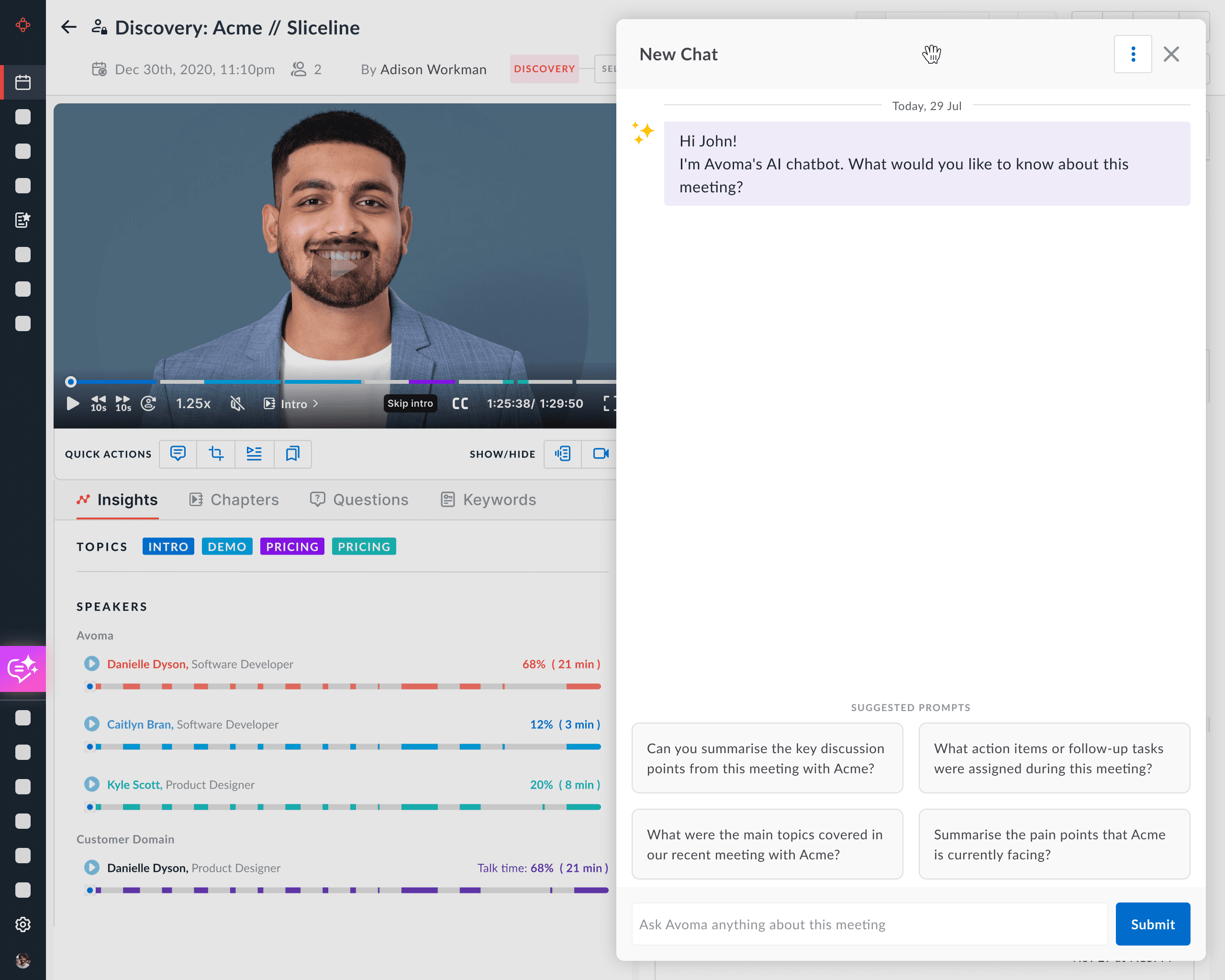
Avoma Copilot
Defining an AI Copilot through Research to Enable Smarter Revenue Decisions

Overview
Sales conversations contain valuable signals about deal risks, customer intent, and next actions. However, teams struggle to consistently extract insights from calls, leading to missed opportunities and reactive decision-making.
Instead of starting with UI, this project focused on understanding how sales teams review conversations, make decisions, and where AI could meaningfully assist.
I led research to define the core problems, user expectations, and high-impact use cases that shaped the direction of Avoma Copilot.
Overview
Sales conversations contain valuable signals about deal risks, customer intent, and next actions. However, teams struggle to consistently extract insights from calls, leading to missed opportunities and reactive decision-making.
Instead of starting with UI, this project focused on understanding how sales teams review conversations, make decisions, and where AI could meaningfully assist.
I led research to define the core problems, user expectations, and high-impact use cases that shaped the direction of Avoma Copilot.
Problem
Early assumptions positioned Copilot as a conversation summary or coaching tool.
However, initial discussions revealed deeper questions:
What decisions do users actually make after a call?
Who benefits most from AI insights?
What level of automation would users trust?
When does AI add value vs create noise?
The risk:
"Building a feature that generates information — but not real business value."
Research Objectives
Understand how conversations influence deal decisions
Identify decision moments after a call
Define high-value AI use cases
Understand trust expectations for AI recommendations
Problem
Early assumptions positioned Copilot as a conversation summary or coaching tool.
However, initial discussions revealed deeper questions:
What decisions do users actually make after a call?
Who benefits most from AI insights?
What level of automation would users trust?
When does AI add value vs create noise?
The risk:
"Building a feature that generates information — but not real business value."
Research Objectives
Understand how conversations influence deal decisions
Identify decision moments after a call
Define high-value AI use cases
Understand trust expectations for AI recommendations
Research Approach
1. Call Review Analysis
I analyzed multiple real conversations and documented:
What managers look for during reviews
Information extracted manually
Decisions made after analysis
Observation -
"Users weren’t looking for summaries — they were extracting risks, intent, objections, and next steps."
User Interviews
Interviewed:
Sales Managers
Account Executives
Enablement Leads
Key questions:
What do you look for after a call?
What slows you down?
When do you re-listen to recordings?
What decisions do you make based on conversations?
Research Approach
1. Call Review Analysis
I analyzed multiple real conversations and documented:
What managers look for during reviews
Information extracted manually
Decisions made after analysis
Observation -
"Users weren’t looking for summaries — they were extracting risks, intent, objections, and next steps."
User Interviews
Interviewed:
Sales Managers
Account Executives
Enablement Leads
Key questions:
What do you look for after a call?
What slows you down?
When do you re-listen to recordings?
What decisions do you make based on conversations?
The actual conversation with users
Research Question
Sales Manager (Pratyush)
Account Executive (Aditya)
Enablement / Sales Leader (Everett)
Key Insight
What do you look for after a call?
“I’m checking if there were any objections or hesitation from the customer.”
“I want to know if there’s any risk before we move forward.”
“I just want to quickly recall what the customer cared about and what they asked.”
“I’m looking for patterns - where reps are missing key questions or positioning.”
Different roles look for risk, context recall, and performance signals.
How do you currently review conversations?
“I skim the transcript and jump to customer-heavy sections.”
“For big deals, I end up listening to the full call.”
“I open the transcript before my next meeting to refresh my memory.”
“I don’t have time to review full calls - I rely on highlights or manager feedback.”
Review is manual and time-consuming; needs faster understanding.
What takes the most time?
“Finding the important moments - where the deal could go wrong.”
“Figuring out what I missed or should have asked.”
“Identifying coaching opportunities across multiple calls.”
Opportunity to surface key moments automatically.
What decisions do you make after reviewing a call?
“Is this deal healthy?”
“Do we need to intervene or change strategy?”
“What should I ask or clarify in the next call?”
“Does this rep need coaching on discovery, objection handling, or positioning?”
Core need is decision-making, not just information.
What would make AI useful for you?
“Tell me if the deal is at risk or if the customer raised concerns.”
“Suggest what I should focus on in the next conversation.”
“Highlight where reps missed opportunities or didn’t follow the playbook.”
AI should provide risks, next steps, and coaching signals.
What makes you trust AI?
“I need to see the exact transcript where this insight came from.”
“I want to edit the suggestions before using them.”
“Insights should be concise and structured - I won’t read long summaries.”
Trust requires evidence, editability, and concise output.
When would you use Copilot?
“During pipeline reviews or when a deal looks stuck.”
“Right before my next customer meeting.”
“During performance reviews or coaching sessions.”
Copilot should support decision moments in workflow.
The actual conversation with users
Research Question
Sales Manager (Pratyush)
Account Executive (Aditya)
Enablement / Sales Leader (Everett)
Key Insight
What do you look for after a call?
“I’m checking if there were any objections or hesitation from the customer.”
“I want to know if there’s any risk before we move forward.”
“I just want to quickly recall what the customer cared about and what they asked.”
“I’m looking for patterns - where reps are missing key questions or positioning.”
Different roles look for risk, context recall, and performance signals.
How do you currently review conversations?
“I skim the transcript and jump to customer-heavy sections.”
“For big deals, I end up listening to the full call.”
“I open the transcript before my next meeting to refresh my memory.”
“I don’t have time to review full calls - I rely on highlights or manager feedback.”
Review is manual and time-consuming; needs faster understanding.
What takes the most time?
“Finding the important moments - where the deal could go wrong.”
“Figuring out what I missed or should have asked.”
“Identifying coaching opportunities across multiple calls.”
Opportunity to surface key moments automatically.
What decisions do you make after reviewing a call?
“Is this deal healthy?”
“Do we need to intervene or change strategy?”
“What should I ask or clarify in the next call?”
“Does this rep need coaching on discovery, objection handling, or positioning?”
Core need is decision-making, not just information.
What would make AI useful for you?
“Tell me if the deal is at risk or if the customer raised concerns.”
“Suggest what I should focus on in the next conversation.”
“Highlight where reps missed opportunities or didn’t follow the playbook.”
AI should provide risks, next steps, and coaching signals.
What makes you trust AI?
“I need to see the exact transcript where this insight came from.”
“I want to edit the suggestions before using them.”
“Insights should be concise and structured - I won’t read long summaries.”
Trust requires evidence, editability, and concise output.
When would you use Copilot?
“During pipeline reviews or when a deal looks stuck.”
“Right before my next customer meeting.”
“During performance reviews or coaching sessions.”
Copilot should support decision moments in workflow.
Across roles, users weren’t asking for summaries — they wanted answers to:
Is this deal at risk?
What did the customer really care about?
What should I do next?
This reframed Copilot as a decision-support assistant, not a conversation summary tool.
Across roles, users weren’t asking for summaries — they wanted answers to:
Is this deal at risk?
What did the customer really care about?
What should I do next?
This reframed Copilot as a decision-support assistant, not a conversation summary tool.
Work in Progress..
Work in Progress..
Avoma AI Coaching Assistant
Avoma AI Coaching Assistant


Navigation
Case studies
© Feb 2026 Aishwarya Chandan
Navigation
Case studies
© Feb 2026 Aishwarya Chandan
Navigation
Case studies
© Feb 2026 Aishwarya Chandan